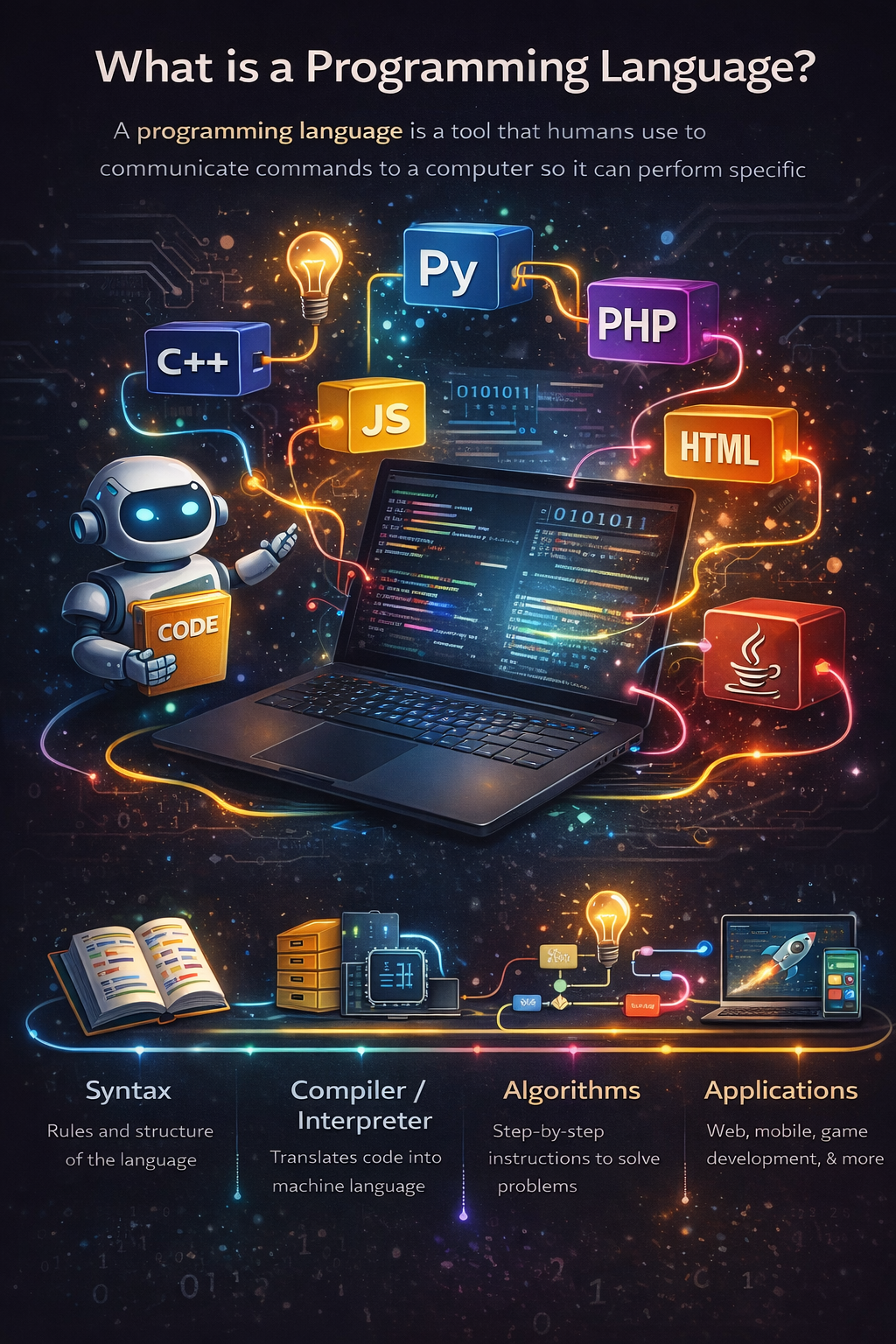
A programming language is a tool that allows humans to communicate with a computer and instruct it on what tasks to perform. Since computers only understand machine language—zeros and ones—programming languages are designed as an intermediary to translate human instructions into a form that machines can understand.
Each programming language has its own set of rules, structures, and keywords, which are referred to as its “syntax.” If these rules are not followed correctly, the program will not run or will result in errors. Therefore, learning the syntax and structure of a language is considered the first step into the world of programming.
Programming languages are generally divided into two main categories based on their level: low-level languages and high-level languages. Low-level languages such as Assembly are closer to hardware and more complex, while high-level languages like Python, JavaScript, and Java are closer to human language and easier to learn.
Each programming language is designed for a specific purpose. For example, HTML and CSS are used to build and design web pages, JavaScript is used to create interaction and dynamism on the web, Python is used for data analysis, artificial intelligence, and automation, and Java or C# are used to build large-scale software and applications. Choosing the right language depends on the type of project and the programmer’s goal.
Programming languages are typically executed in two ways: compiled and interpreted. In compiled languages such as C++, the entire program is first translated into machine code and then executed. In interpreted languages such as JavaScript and Python, the code is read and executed line by line. Each approach has its own advantages and disadvantages.
Learning a programming language does not simply mean memorizing commands; it means learning how to think logically, solve problems, and design algorithms. When a person learns one programming language, they actually gain a skill that helps them learn other languages more easily as well.
In today’s world, knowing at least one programming language has become a major advantage. Many jobs are directly or indirectly related to programming. For this reason, learning programming languages is not only beneficial for programmers, but also a smart choice for anyone who wants to keep up with technology.