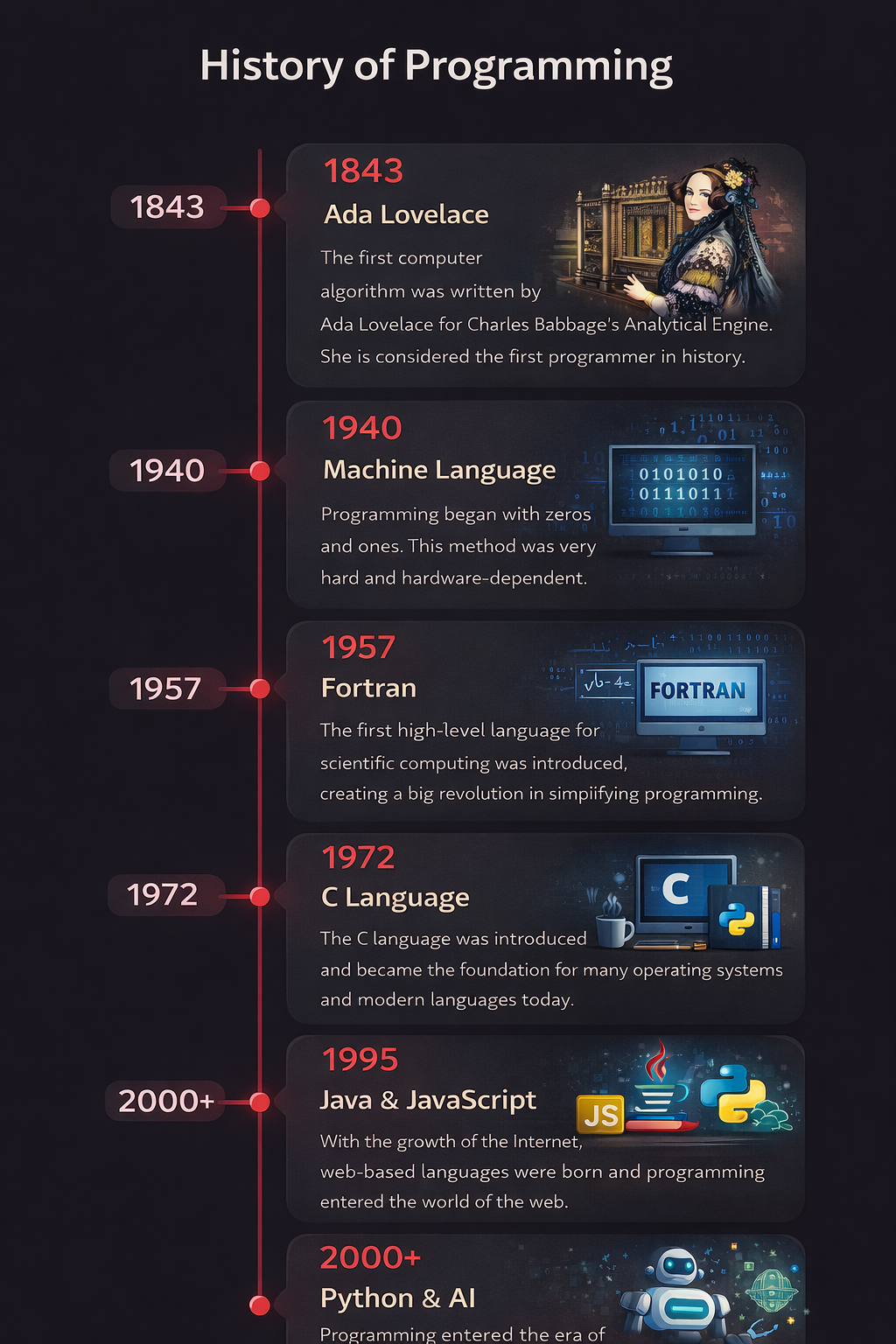
The history of programming dates back to years before the invention of modern computers. The earliest ideas related to programming emerged when humans attempted to automate calculation processes. In the nineteenth century, Charles Babbage laid the conceptual foundations of modern computers by designing the “Analytical Engine.”
During the same period, Ada Lovelace—known as the world’s first programmer—wrote an algorithm for Babbage’s Analytical Engine. This algorithm is considered the first computer program in history. Although the machine was never fully built, concepts such as instructions, variables, and loops were introduced for the first time.
With the beginning of the twentieth century and advances in technology, electronic computers emerged. In the 1940s, programming was done directly in machine language, meaning programmers had to work with zeros and ones. This method was extremely difficult, time-consuming, and prone to errors.
To simplify the programming process, assembly language was introduced. Assembly language allowed programmers to use mnemonic instructions instead of zeros and ones. However, this language was still highly dependent on hardware and was not suitable for large-scale projects.
In the 1950s and 1960s, high-level languages such as Fortran and COBOL were developed. These languages enabled programmers to focus on program logic rather than hardware details. This transformation is considered a major turning point in the history of programming.
As computer usage expanded, more diverse languages such as C, Pascal, and later C++ were created. The C language, due to its high performance and effective control over system resources, played a crucial role in the development of operating systems and low-level software.
In the 1990s, with the rise of the Internet, programming entered a new phase. Languages such as Java and JavaScript were developed to enable the creation of web-based and cross-platform applications. During this period, software design and user experience became increasingly important.
In recent years, languages such as Python have gained great popularity due to their simplicity and power. Today, programming is no longer limited to software development; it also plays a key role in fields such as artificial intelligence, data science, the Internet of Things, and cybersecurity.
The history of programming shows that this field has always been evolving. From punch cards and machine language to artificial intelligence and machine learning, programming has followed a long and fascinating path and remains one of the most important skills of the digital age.