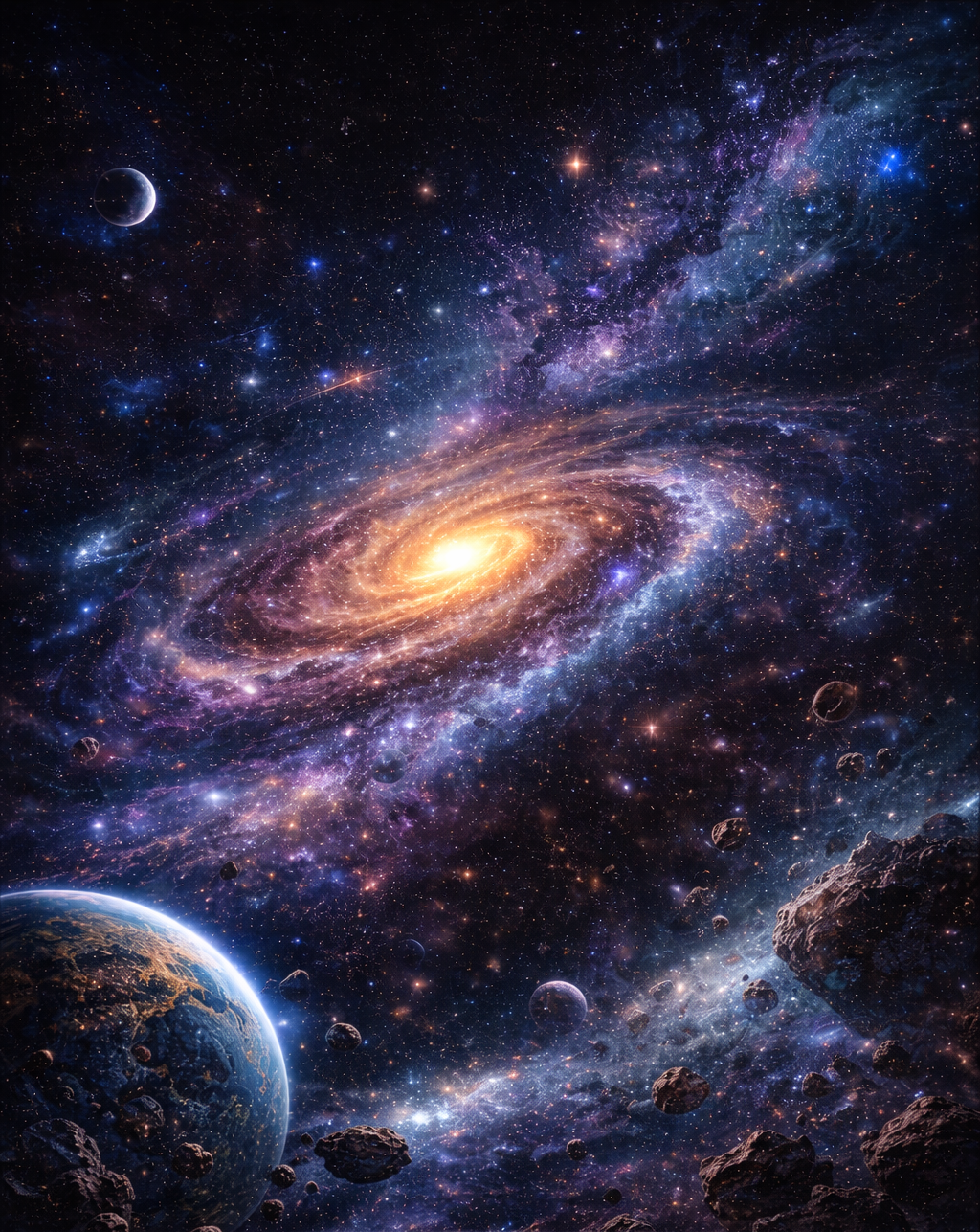
What Is Space?
Space, or the “cosmos,” refers to the entire expanse that includes everything known and unknown in the universe—from planets and stars to galaxies, energy, time, and even invisible forms of matter. Space is where Earth and everything we know exists, and no definitive boundary can be imagined for it.
Contrary to popular belief, space is not completely empty. Within this vast vacuum, there are extremely small particles of gas, cosmic dust, radiation, and gravitational fields. These seemingly insignificant elements play a major role in the formation of stars, planets, and the structure of the universe.
Where Does Space Begin?
There is no clear or precise boundary between Earth’s atmosphere and space, but by convention, a line known as the “Kármán Line” at an altitude of about 100 kilometers above Earth’s surface is considered the beginning of space. Beyond this point, the air becomes so thin that airplanes can no longer fly, and only spacecraft are able to operate.
Upon entering space, the familiar laws of life on Earth change. Gravity becomes extremely weak, sound cannot travel, and temperatures can range from hundreds of degrees below zero to hundreds of degrees above zero. These extreme conditions make space a highly challenging environment for humans.
The Incredible Vastness of Space
The vastness of space is so immense that it is difficult for the human mind to fully comprehend. Light, which travels at a speed of about 300,000 kilometers per second, may take billions of years to cross the distance between galaxies. For this reason, scientists use a unit called a “light-year” to measure distances in space.
The Milky Way galaxy, which we call home, contains hundreds of billions of stars and is only one of billions of galaxies in the universe. Each of these galaxies may host billions of planets, some of which might have the necessary conditions for life.
Why Is Studying Space Important?
Studying space is not merely a scientific curiosity—it plays a crucial role in technological advancement and in helping us better understand humanity’s place in the universe. Many modern technologies such as GPS, satellite communications, weather forecasting, and even certain medical devices are the result of space research.
Moreover, exploring space helps us find scientific answers about the origin of the universe, the formation of planets, and even the possibility of life beyond Earth. Perhaps the answer to one of humanity’s greatest questions— “Are we alone in the universe?”—lies hidden within space itself.
Space: Humanity’s Final Frontier
Space has always inspired humanity—from ancient myths and legends to science-fiction movies and novels. Today, with the advancement of technology, humans have taken more tangible steps toward this unknown frontier and envision a future in which living on other planets may be possible.
Space is not only a physical place, but also a symbol of curiosity, progress, and humanity’s endless pursuit of discovering the unknown—a boundless realm where every answer gives rise to new questions.