What Are Stars?
Stars are massive and luminous objects in space composed of extremely hot gases, primarily hydrogen and helium. Through nuclear reactions in their cores, they generate enormous amounts of energy that radiate outward as light and heat. The Sun, the closest star to Earth, is an example of such stars—without it, life on Earth would not be possible.
Stars are not only sources of light in the universe, but also play a fundamental role in the formation of planets, chemical elements, and even the emergence of life. Many of the elements found in the human body today were formed deep within stars.
How Does the Birth of Stars Begin?
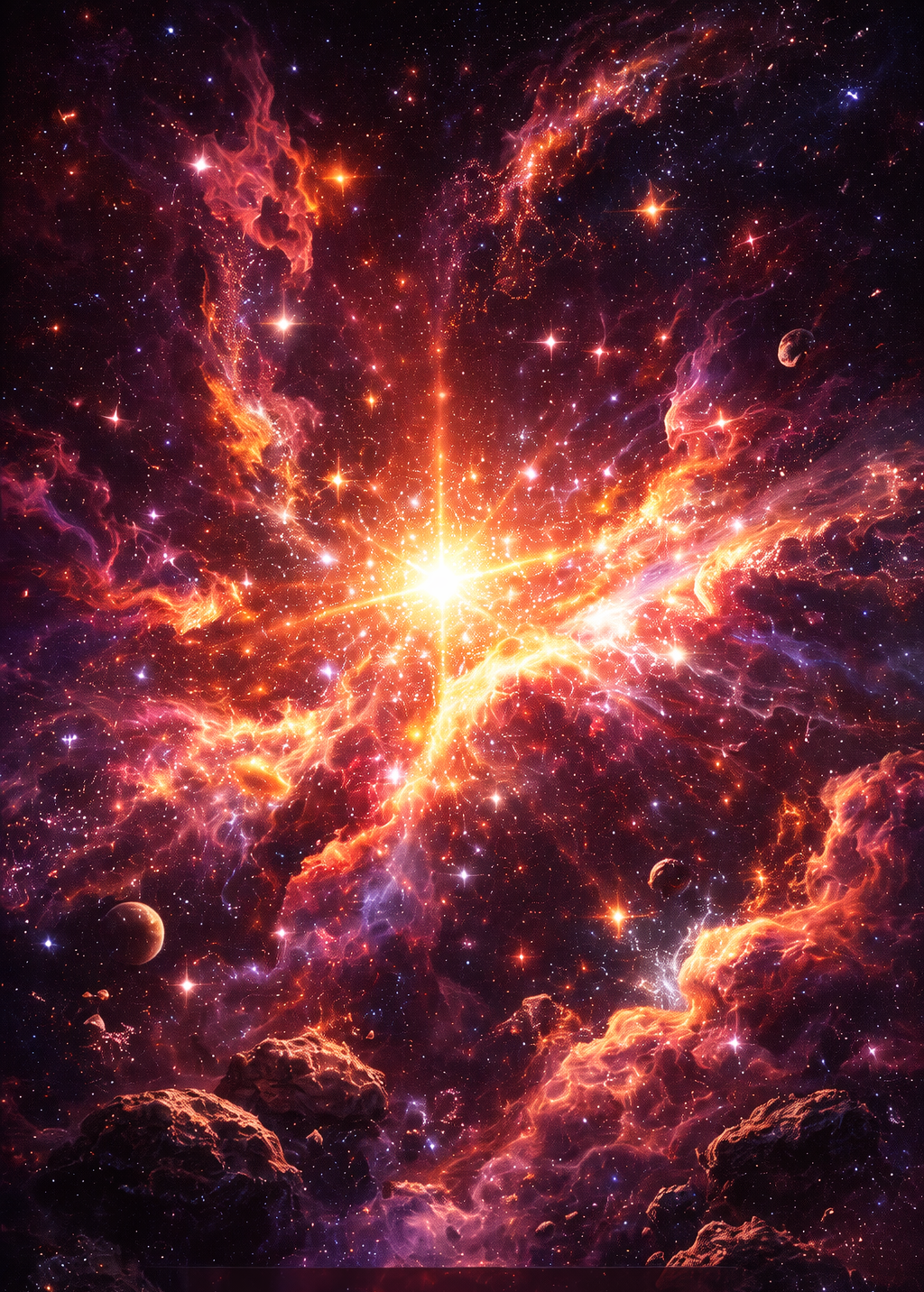
The birth of stars occurs in specific regions of space called “nebulae.” Nebulae are vast clouds of gas and cosmic dust scattered throughout galaxies. These clouds are usually very cold and dark, yet they hold the potential for the formation of new stars.
When a portion of a nebula becomes compressed due to events such as a supernova explosion or the collision of gas clouds, gravity begins to take effect. This gravitational force causes material to collapse toward the center, forming a denser mass.
The Protostar Stage
As gas and dust continue to collapse, a hot core known as a “protostar” forms. At this stage, nuclear reactions have not yet begun, but temperature and pressure steadily increase. The protostar gradually accumulates more mass from its surroundings and grows larger.
This stage may last for millions of years. During this time, the protostar does not emit much light; most of its energy is released as heat generated by gravitational contraction.
The Beginning of Nuclear Fusion
When the temperature at the center of the protostar reaches approximately 10 million degrees Celsius, nuclear fusion begins. In this process, hydrogen atoms fuse into helium, releasing an immense amount of energy. This moment can be considered the official birth of a star.
From this point onward, the star enters a phase known as the “main sequence,” during which it spends the majority of its lifetime. Our Sun is currently in this very stage.
Types of Stars
Stars are classified into different types based on their mass, temperature, and size. Some are small and faint stars known as “red dwarfs.” In contrast, there are extremely massive and luminous stars called “blue giants,” which have shorter lifespans but produce far greater amounts of energy.
A star’s mass is the primary factor that determines its fate. Massive stars consume their fuel more rapidly and may end their lives in colossal explosions known as supernovae.
The Importance of Stars in the Universe
Stars are factories for producing heavy elements. Elements such as carbon, oxygen, iron, and many others are created within stars and are dispersed into space at the end of their lifetimes. These elements later play a crucial role in the formation of planets and living organisms.
Simply put, we humans are made of “star dust.” Studying the birth of stars not only helps us understand the structure of the universe, but also reveals our deep connection with the cosmos.