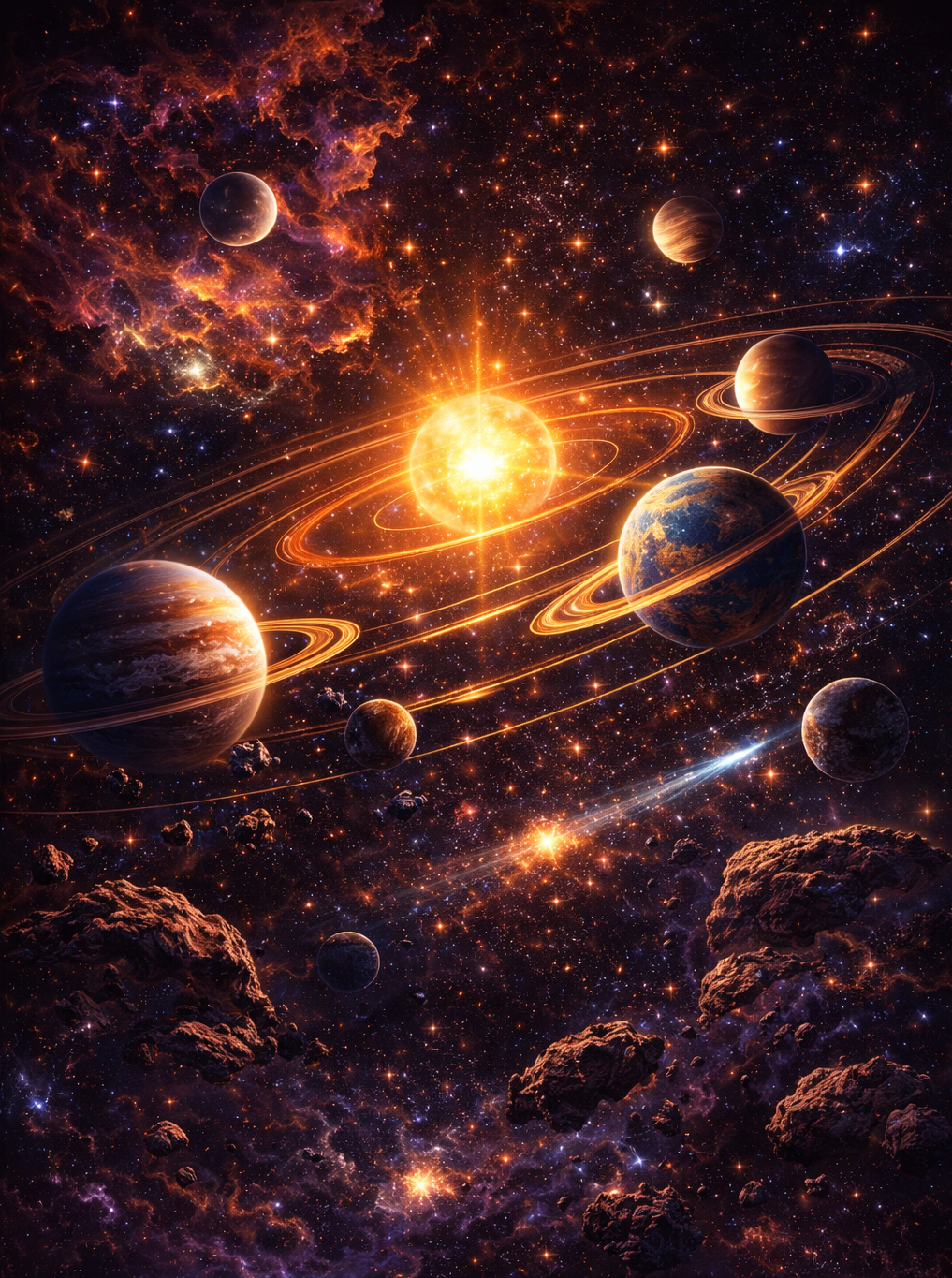
What Is the Solar System?
The Solar System is a collection of celestial objects that orbit a central star—the Sun—under the influence of its gravitational force. This system includes planets, moons, asteroids, comets, and tiny cosmic particles. The Sun, containing more than 99 percent of the total mass of the system, plays the primary role in maintaining its structure.
The planets of the Solar System move along specific paths called “orbits.” These orbits are elliptical, and each planet travels around the Sun at a different speed. The distance of each planet from the Sun plays a crucial role in determining its physical characteristics and environmental conditions.
What Is a Planet?
A planet is a celestial body that orbits a star, has sufficient mass to achieve an almost spherical shape, and has cleared its orbital neighborhood of other objects. This definition, provided by the International Astronomical Union, led to the reclassification of some bodies, such as Pluto, which is no longer considered a major planet.
Unlike stars, planets do not produce their own light. Instead, they reflect the light of the Sun or their central star, which is why they can be observed from Earth.
Rocky Planets and Gas Giants
The planets of the Solar System are divided into two main categories: rocky planets and gas giants. Mercury, Venus, Earth, and Mars are rocky planets with solid surfaces, composed mainly of rock and metal.
In contrast, Jupiter, Saturn, Uranus, and Neptune are considered gas or ice giants. These planets are extremely large and are composed mostly of gases such as hydrogen and helium. Surface conditions on these planets make landing on them nearly impossible.
Earth: A Unique Planet
Earth is the only known planet that possesses the necessary conditions for life. The presence of liquid water, suitable temperatures, a protective atmosphere, and a magnetic field are among the factors that make Earth a safe place for living organisms.
Earth’s distance from the Sun places it within a region known as the “habitable zone.” In this zone, temperatures are neither high enough to cause water to evaporate nor low enough for it to freeze.
Moons and Other Objects
Many planets have moons. Moons are celestial bodies that orbit planets. Earth’s Moon is the most familiar example, but planets such as Jupiter and Saturn have dozens of moons with diverse characteristics.
In addition to moons, the Solar System includes the asteroid belt between Mars and Jupiter, the Kuiper Belt at the outer edge of the system, and the Oort Cloud at extremely distant regions. These areas are rich in icy and rocky objects that provide valuable information about the formation of the Solar System.
Other Solar Systems
With advances in technology, scientists have discovered thousands of exoplanets orbiting stars other than the Sun. These systems demonstrate that our Solar System is just one of countless planetary systems within the galaxy.
Studying other solar systems helps scientists better understand how planets form, their diversity, and the potential for life beyond Earth.
The Importance of Studying Planets
Exploring planets and solar systems helps us better understand Earth’s past, present, and future. Learning about the conditions of other planets can provide clues about climate change, natural resources, and even the ultimate fate of our planet.
Solar systems are remarkable examples of order within the cosmos—structures that reveal how the universe is shaped by precise and harmonious laws.