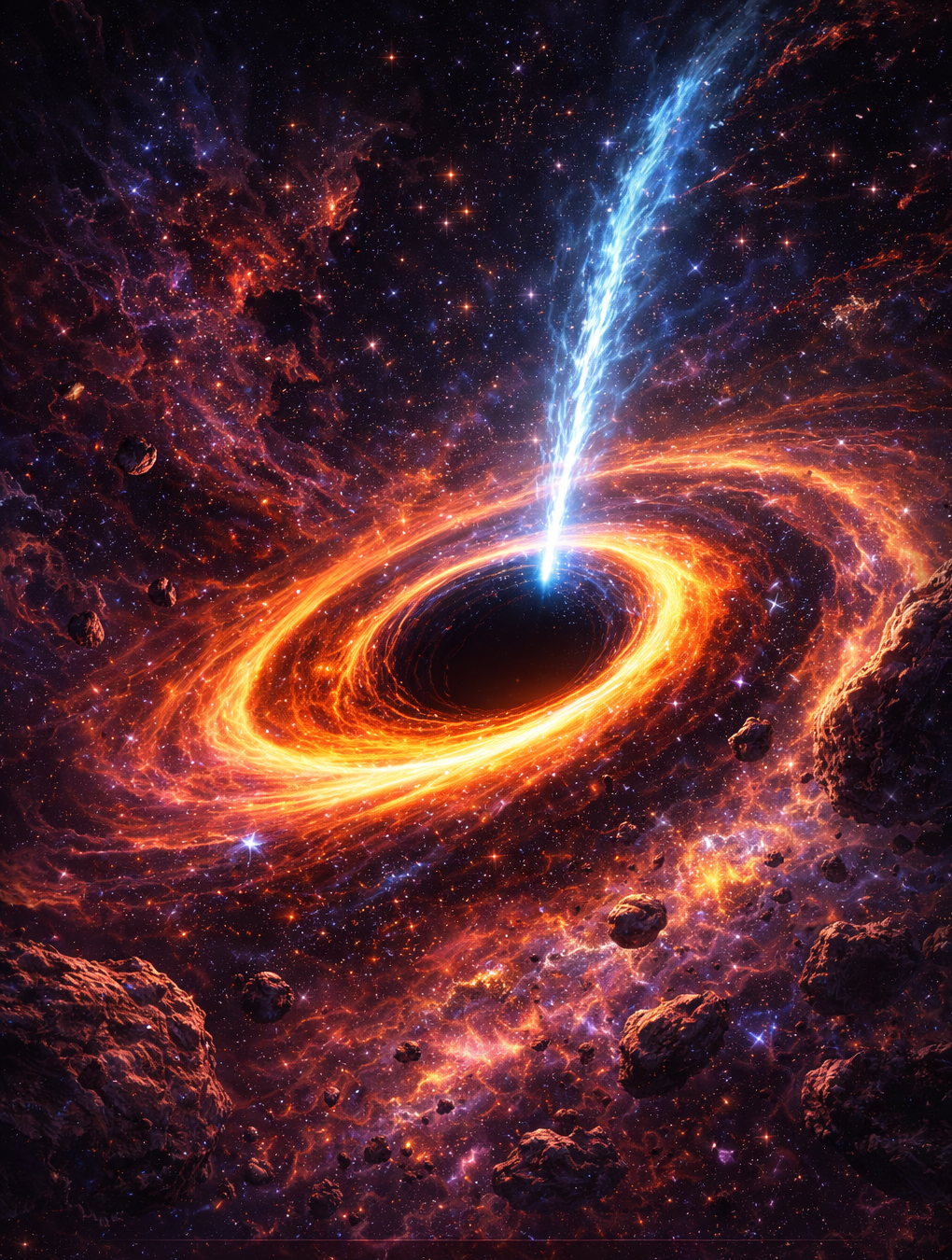
What Is a Black Hole?
A black hole is one of the most fascinating and at the same time most mysterious phenomena known in the universe. A black hole is a region of spacetime where gravity is so strong that nothing—not even light—can escape from it. This property makes black holes effectively invisible and detectable only through their effects on the surrounding environment.
The concept of black holes originates from Albert Einstein’s theory of general relativity, which shows that mass and energy can curve the fabric of space and time. When an enormous amount of mass is concentrated within an extremely small region, the curvature of spacetime becomes so intense that a black hole is formed.
How Do Black Holes Form?
The most common type of black holes forms from the death of very massive stars. When a massive star exhausts its nuclear fuel, it no longer has the force needed to counteract gravity. As a result, the core of the star collapses, and a tremendous explosion known as a supernova occurs.
If the remaining mass after this collapse is large enough, no force can stop it, and a stellar black hole is ultimately born. These black holes typically have masses several times greater than that of the Sun.
Types of Black Holes
Black holes are classified into several categories based on their mass. Stellar black holes are the smallest known type. In contrast, supermassive black holes have masses ranging from millions to billions of times the mass of the Sun.
Nearly all galaxies, including the Milky Way, contain a supermassive black hole at their center. The central black hole of our galaxy is called “Sagittarius A*” and plays an important role in maintaining the stability of the galaxy’s structure.
The Event Horizon: The Point of No Return
The event horizon is an invisible boundary surrounding a black hole. Anything that crosses this boundary has no way of returning. Even light, once it passes the event horizon, becomes trapped by the black hole’s gravitational pull.
The event horizon can be considered the point where the classical laws of physics no longer apply, and the behavior of matter and time becomes highly unusual.
What Happens Inside a Black Hole?
At the center of a black hole lies a point called the singularity. At this point, mass density approaches infinity, and the known laws of physics break down. Scientists still do not have a complete understanding of what occurs within the singularity.
Some theories suggest that black holes may be connected to other universes or even different dimensions, but these ideas remain purely hypothetical.
Do Black Holes Swallow Everything?
Contrary to popular belief, black holes do not act like cosmic vacuum cleaners. If the Sun were suddenly to turn into a black hole, Earth’s orbit would not change significantly; the only difference would be the absence of sunlight to warm our planet.
Black holes absorb matter only when it comes sufficiently close to them. Otherwise, objects can continue their motion at a safe distance.
Hawking Radiation: A Glimmer of Light
Stephen Hawking proposed a theory suggesting that black holes are not completely black. According to this theory, black holes emit a very small amount of radiation known as “Hawking radiation.”
This radiation causes black holes to gradually lose mass and, after billions of years, eventually evaporate completely.
The Importance of Studying Black Holes
Black holes serve as natural laboratories for exploring the fundamental laws of physics. Studying them helps scientists better understand the relationship between gravity, quantum mechanics, and the structure of spacetime.
The mysteries of black holes have not yet been fully revealed, but each new discovery brings us one step closer to a deeper understanding of the universe and humanity’s place within this boundless cosmos.